
Towns County Scheduled Versus Actual Release
A projected date is a forward-looking calculation or estimate. An actual release date records when custody ended in that system. The two can differ because a court changes credit, the jail completes bond processing later, GDC recalculates a sentence, the Parole Board changes a tentative month, or another agency has placed a hold.
A pretrial detainee does not serve a fixed sentence merely because the roster shows days in jail. Release may follow the posting of bond, dismissal, a court order, or resolution of a hold. A transfer to Georgia Department of Corrections custody is not a release. For a sentenced person, the controlling judgment and any lawful credit form the starting point.
Several dates can appear in one case. A sentence start, parole eligibility date, TPM, maximum possible release date, and actual release date are not interchangeable. Eligibility is the point when consideration may begin. A maximum date reflects the outer end shown by the state record, subject to lawful change. The actual date is historical. Reading the field label and source agency prevents a planning date from being reported as a completed release.
Find a Towns County Release Date
Choose the path by custody type. The Towns County roster is useful for current status and previous-booking history, but it is not a sentence calculator. GDC covers state offenders. The Parole Board controls tentative parole timing, while the court preserves the sentence and later amendments.
- Check the Towns roster to learn whether local custody appears active.
- Search by booking date with previous inmates included when available.
- For local custody, call the jail and compare the court order.
- Request a written release record when the online history is incomplete.
- For state custody, open the GDC Find an Offender record.
- Use the TPM lookup only for tentative parole timing.
- Confirm a reported release against the agency that held the person.
For a broader identity and records sequence, the Towns County released-inmate lookup separates current jail custody, prior local bookings, court disposition, state prison, and federal custody.
Towns County Jail Date Computation
No public Towns County jail good-time, earned-time, or weekend-release policy was found. That absence should not be filled with a rule from another county. A local jail date can depend on the sentencing order, credit for time served, jail credit, bond, warrants, detainers, state or federal holds, and administrative processing.
A bond release follows bond posting and processing, not a sentence-credit formula. Towns County says bonding is completed at the jail. When the question concerns a sentenced local term, compare the judgment with jail records. Towns County Detention Center can be reached at (706) 896-5474. For a durable record, the Sheriff's Office accepts its printed open-records form by email, mail, or hand delivery.
- Jail credit
- Time credited by the sentence or court record toward confinement.
- Time served
- A court outcome that treats time already spent in custody as the required confinement.
- Detainer
- A request or hold from another authority that may prevent the person from going home.
- Transfer
- A move to another custodian, which is not release from custody.
GDC Towns County Release Records
GDC Find an Offender is the primary route for a person serving a Georgia state sentence. Search fields include a name and GDC identifier. The detailed record can show the facility, current status, charges, sentence data, a maximum possible release date or release date when present, and an offender photograph when available.
Do not use GDC as the first source for an ordinary Towns County bond release. A local detainee may never enter GDC. Once a sentenced person transfers to state custody, however, the state record becomes the right place to track the facility and state-calculated date.
The GDC release-date and time-computation information explains that Find an Offender provides release-date information and routes parole issues elsewhere.
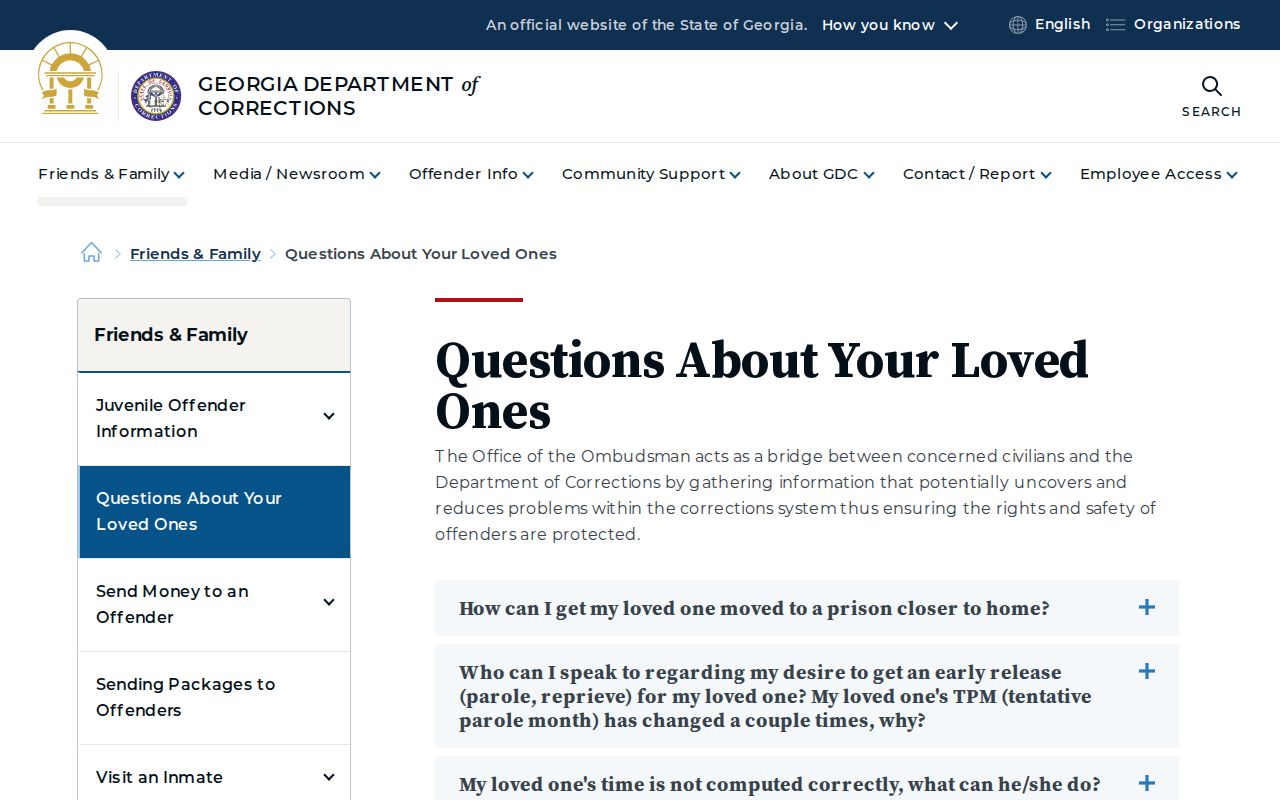
GDC also asks users to verify offender information through written correspondence with Inmate Records and Information at P.O. Box 1529, Forsyth, GA 31029. That check is especially useful when a date appears inconsistent with the sentence or known jail credit.
Towns County Parole Timing Rules
Georgia's “Tentative Parole Month,” or TPM, is not a final release date. The Parole Board uses it as the month for final review and may then set a parole release date. The Board can deny parole, reconsider a decision, or condition a TPM on good conduct, required programs, and an acceptable residence plan.
Under O.C.G.A. § 42-9-45, misdemeanor parole eligibility generally arises after six months or one-third of the sentence, whichever is greater. Felony eligibility generally arises after nine months or one-third, whichever is greater, unless another law applies. Aggregate sentences of at least 21 years may reach eligibility after seven years, subject to statutory exceptions. Eligibility only permits consideration. It does not create a right to release.
O.C.G.A. § 17-10-6.1 and related rules create serious-violent-felony limits and mandatory terms. Georgia does not apply one simple “85 percent” rule to every state inmate or Towns County jail sentence. The offense, date, sentence, recidivist status, and parole law must be reviewed together.
Why Towns County Release Dates Change
A date can move for reasons that arise in court, at the jail, within GDC, or during parole review. The effect depends on which agency owns the decision. A VINE alert reports a custody change but does not calculate the sentence.
| Factor | Possible effect | Best source |
|---|---|---|
| Amended sentence or jail-credit correction | Moves the controlling term or credited start point. | Court order and GDC or jail record |
| Disciplinary misconduct | May postpone or cancel a TPM. | GDC and Parole Board |
| Program progress | Eligible state inmates may receive a limited TPM advance through PIC. | Parole Board |
| Residence-plan review | May delay parole until a plan is accepted. | Parole Board and DCS |
| Detainer or other hold | Can cause transfer to another authority rather than a return home. | Holding agency and requesting authority |
| Bond processing | Changes when a pretrial local release is completed. | Towns County jail and court |
| Custody transfer | Moves responsibility to county, state, federal, or immigration custody. | Both sending and receiving agencies |
Performance Incentive Credit, or PIC, is a Georgia state parole concept. For an eligible inmate, satisfactory progress in education, treatment, or work may advance a TPM by a few months. It is not a published Towns County jail credit. Misconduct can have the opposite effect.
Correct Towns County Date Errors
GDC says a state inmate who believes time computation is wrong should begin with the counselor. The issue may then require the clerk of court in the county of conviction because the judgment or local jail credit comes from court records. If Towns County is the county of conviction, the Clerk of Superior Court handles criminal proceeding records at 48 River Street, Suite E, Hiawassee, GA 30546, and can be reached at 706-896-2130.
A local jail record problem follows a different route. Compare the roster history, release record, and sentencing order. Ask for existing fields and documents rather than asking the Sheriff's Office to create a new calculation. Georgia's Open Records Act does not require an agency to create a report that does not exist.
Under O.C.G.A. § 50-18-71, an agency generally must produce available responsive public records within three business days or explain when they can be produced. A narrow Towns request can identify the person, booking date, sentence or order, credited time, release date, release reason, and transfer destination. The response may still redact exempt material. Existing custody fields are more useful than a request for an unsourced estimate.
Reconcile Towns County Date Records
Release-date disputes often involve two offices because one office holds the sentence while another applies it. Towns Superior Court records the judgment and later court changes. The jail records local custody and release processing. GDC computes a state sentence after transfer. The Parole Board controls parole decisions. A mismatch should be traced to the field that differs, not resolved by choosing whichever online date appears first.
For a Towns County judgment, obtain the sentence and any amended order from the Clerk of Superior Court. Compare the confinement term, dates, and credit language against the jail or GDC record. The clerk's office is at 48 River Street, Suite E, Hiawassee, and its published hours are Monday through Friday, 8:30 a.m. to 4:30 p.m. The clerk can provide court records but does not run jail release processing or make a parole decision.
- Copy the exact field label and date that appears wrong.
- Identify whether the source is the jail, court, GDC, or Parole Board.
- Obtain the controlling judgment and any amended order.
- Compare stated jail credit with the agency's computed record.
- For GDC computation, begin with the inmate's counselor.
- Send court-document issues to the clerk in the county of conviction.
Do not treat a TPM correction as a GDC release-date correction. GDC's own guidance sends tentative parole matters to Pardons and Paroles. Likewise, a Towns bond order does not establish that the jail has finished release processing. The agency that controls the disputed step must confirm its completion.
Retain the source and date for each answer. The Towns roster is dynamic, and no official update cadence or retention period is published for it. A saved roster result can help identify the booking, but the court order and written agency response carry the clearer record of how the date was reached. When a transfer is involved, ask for the receiving agency and transfer date as well as the local release field.
Confirm Towns County Actual Release
When the future date is close, check the holding system again. For Towns County Jail, call the jail, review prior-booking history, and obtain the release record. For GDC, read the status and release date, then verify questionable data with Inmate Records. For parole, distinguish the TPM from a final parole release decision.
A person-specific notice can add a timely signal. The Towns County VINELink release check explains registration and the limits of the participating feed. VINE does not cover Bureau of Prisons custody, and a status change does not rule out a detainer or transfer.
The final answer often requires two records: the administrative custody record and the legal court or parole decision. Read them together. That approach prevents a projected date, an eligibility date, a bond event, or a transfer date from being mistaken for the moment the person actually returned to the community.
If another authority has a detainer, the scheduled end of one custody term may become the start of another. The Parole Board describes a conditional transfer as parole to a detainer. When the receiving authority later releases the person before the Georgia sentence ends, parole supervision may begin. Ask both the sending and receiving agency what happened. A family report that someone “was released” can accurately describe departure from Towns or GDC while still leaving the person in another custodian's control.
Public Record Search
Sponsored Results